





DLAB 340°C Magnetic Hotplate Stirrer Comparison: MS-H-ProA vs Pro+ vs ProT vs ProM

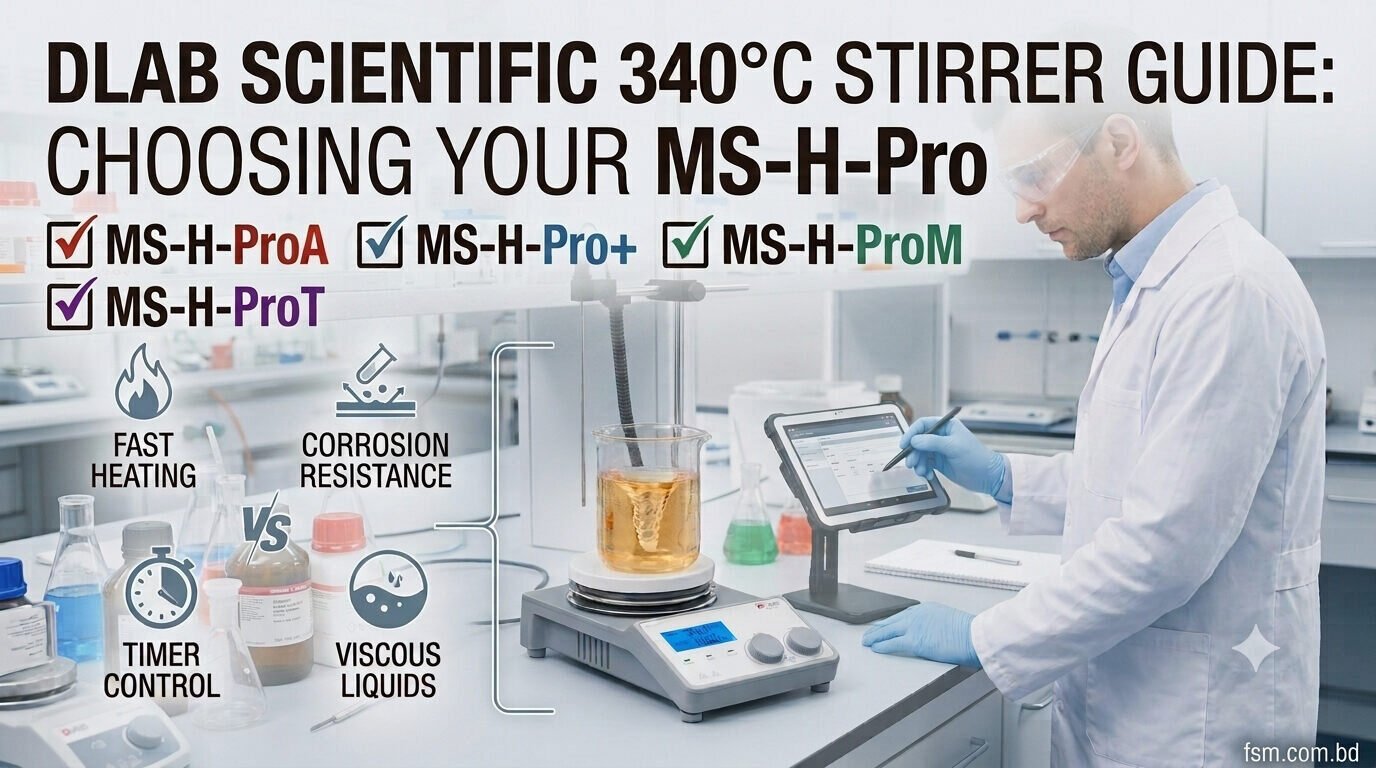
Selecting the right magnetic hotplate stirrer requires matching your laboratory’s workflow with the exact features of the equipment. DLAB Scientific engineered its premium 340°C digital series to deliver highly uniform thermal transfer and powerful mixing performance across various chemical and biological setups.
While all four flagship models—the MS-H-ProA, MS-H-Pro+, MS-H-ProT, and MS-H-ProM—share the same fundamental heavy-duty core parameters, key engineering choices in plate composition, timing hardware, and motor enhancement distinguish them from one another.
Core Technical Foundations Shared Across the 340°C Series
Every model in the DLAB Pro magnetic stirrer family shares a robust technical architecture designed for high-throughput daily workloads:
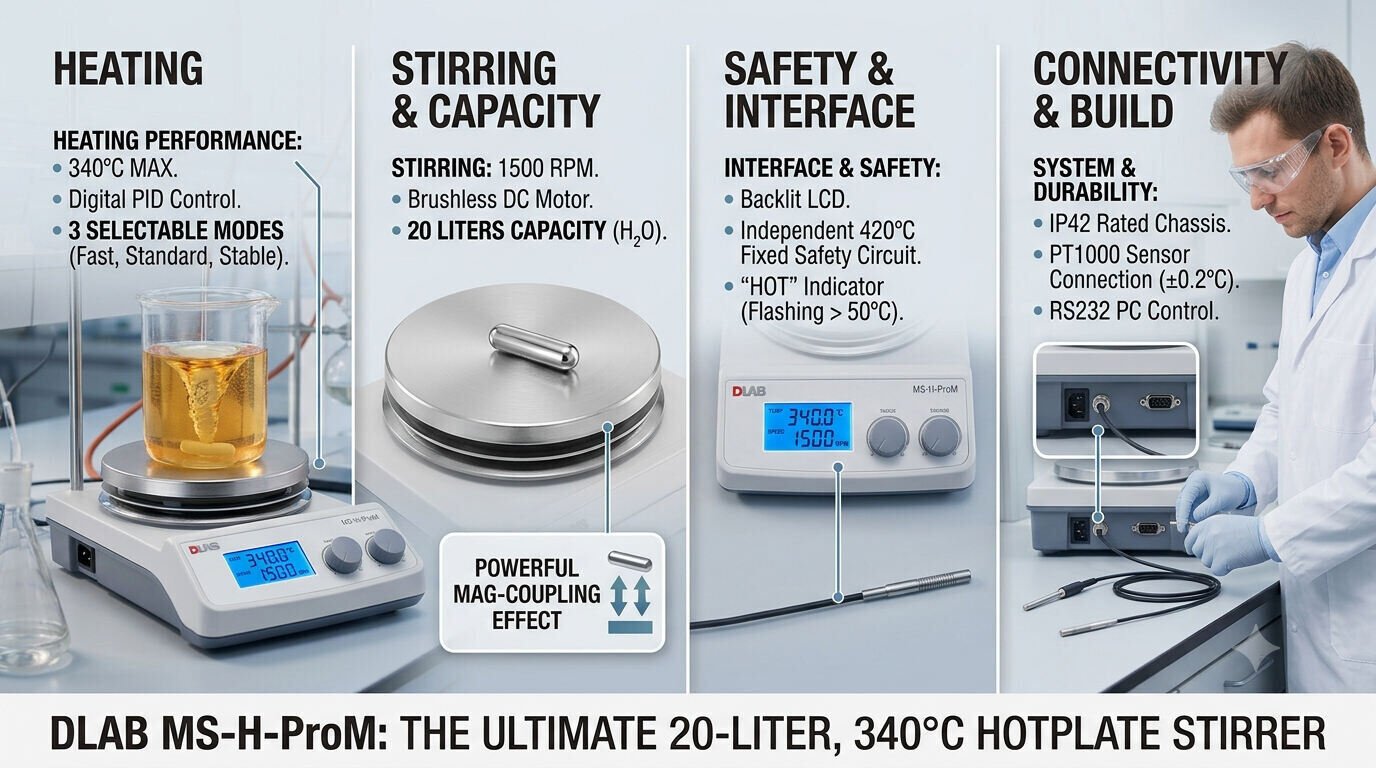
- Stirring Capacity: Consistently handles up to 20 Liters (H2O) of liquid volume.
- Speed Range: Offers smooth digital control from 100 to 1500 rpm with an high accuracy.
- Temperature Reach: Heats from room temperature up to 340°C using an integrated PID controller.
- Drive Mechanism: Features a spark-free, maintenance-free Brushless DC Motor.
- Safety Engineering: Employs dual independent safety circuits with a fixed over-temperature cutoff at 420°C. A highly visible “HOT” flashing indicator remains active anytime the plate temperature exceeds 50°C, even when you switch the main power off.
- External Control: Connects directly to an external PT1000 temperature sensor (delivering 0.2°C accuracy inside the medium) and supports automated PC logging via an RS232 interface.
DLAB MS-H-ProM
- Work Plate Material: Polished aluminum alloy plate with an advanced ceramic coating.
- Enhanced Mixing Core: Integrates upgraded, high-coercivity magnets and a beefed-up motor drive specifically engineered for high-viscosity media.
- Advanced Control UI: Features three selectable heating modes (Fast Heating, Standard Heating, and Steady/Stable Heating) alongside smooth, anti-spill acceleration and deceleration profiles.
- Intelligent Shutoff: Automatically terminates the heating element when the time countdown expires while continuing to stir to protect your samples from localized thermal degradation.
DLAB MS-H-ProA
- Work Plate Material: Aluminum alloy cover with a specialized ceramic coating.
- Thermal Uniformity: High thermal conductivity plate provides the fastest heating speed and outstanding compatibility with dense heating blocks or multi-position quarter-pies.
- Timer Function: Built-in countdown timer ranging from 1 minute to 99 hours and 59 minutes.
- Chassis Protection: Standard laboratory IP21 protection class casing.
DLAB MS-H-Pro+
- Work Plate Material: Pure stainless steel core with an advanced chemical-resistant ceramic coating.
- Corrosion Defense: Provides superior defense against aggressive acids, bases, and volatile organic solvents.
- Timer Function: None. This model functions strictly via continuous, manual runtime operation.
- Chassis Protection: Enhanced IP42 protection class housing, which shields internal electronics significantly better against liquid splashes and dust.
DLAB MS-H-ProT
- Work Plate Material: Stainless steel cover with a chemical-resistant ceramic coating.
- Dedicated Time Tracking: Integrates a physical, high-resolution LCD clock that actively displays the countdown timeline.
- Timer Range: Configurable from 1 minute to 99 hours and 59 minutes.
- Chassis Protection: High-grade IP42 protection class housing for high-moisture environments.
Master Comparison: DLAB 340°C Hotplate Stirrer Series
| Technical Attribute | MS-H-ProA | MS-H-Pro+ | MS-H-ProT | MS-H-ProM (Enhanced) |
| Top Plate Core Base | Aluminum Alloy | Stainless Steel | Stainless Steel | Polished Aluminum |
| Top Plate Coating | Ceramic Coating | Ceramic Coating | Ceramic Coating | Ceramic Coating |
| Timer Functionality | Yes (Integrated) | No (Continuous Only) | Yes (Dedicated Display) | Yes (With Smart Heating Cutoff) |
| IP Protection Class | IP21 | IP42 | IP42 | IP42 / Enhanced Chassis |
| Heating Modes | Standard | Standard | Standard | 3 Modes (Fast, Standard, Steady) |
| Viscosity Optimization | Standard Media | Standard Media | Standard Media | High-Viscosity Liquids |
| Total Power Consumption | 720W | 550W | 550W | 550W (Enhanced Torque) |
Critical Differences Explained: Which One Should You Buy?
1. Plate Chemistry: Aluminum (ProA / ProM) vs. Stainless Steel (Pro+ / ProT)
Aluminum alloy plates deliver maximum heat transfer and uniform thermal distribution across the surface. Choose the ProA or ProM if you regularly use external aluminum quarter-pie blocks or require rapid heating intervals. Stainless steel cores provide unmatched chemical resistance. Select the Pro+ or ProT if your laboratory handles aggressive acids or corrosive cleaning agents that could degrade an aluminum sub-plate over time.
2. Time-Dependent Automation (The Timer Factor)
If your processes require strict temporal tracking, bypass the Pro+, which only supports manual, non-timed operations. The ProA and ProT automatically cut off system processes when the timer ends. However, for sensitive biochemical matrices, the ProM offers the safest profile: it turns off the heating element when the clock hits zero but keeps the magnetic bar spinning to prevent sample burning or precipitation.
3. Viscosity and Mixing Dynamics
Standard models handle low-to-medium viscosity fluids (H2O equivalents) perfectly. If you are mixing dense oils, polymers, cell culture broths, or concentrated buffers that create heavy fluid resistance, the MS-H-ProM stands out. Its enhanced magnets prevent the magnetic stir bar from spin-coupling or breaking away under heavy load.
How do the different MS-H-ProA, Pro, ProT, and ProM models compare in terms of their features and laboratory applications?
While all four models share the same core capacity (up to 20L, 100–1500 rpm, and heating up to 340°C), they differ in plate material, timing control, and viscosity handling:
MS-H-ProA (Fast Heating & General Lab Work): Features an aluminum alloy top plate for high thermal conductivity and fast heating speed. Includes a built-in timer (up to 99h 59m). Best for standard heating blocks and general reactions.
MS-H-Pro+ (Chemical Resistance & Manual Control): Built with a stainless steel ceramic-coated top plate and an IP42 rating for superior resistance against aggressive acids, solvents, and liquid spills. Operates continuously (no timer). Ideal for heavy chemical synthesis.
MS-H-ProT (Chemical Resistance with Timer Control): Combines the corrosion resistance of the stainless steel top plate (IP42) with a dedicated LCD clock timer. Best for time-sensitive, chemical-intensive processes.
MS-H-ProM (High-Viscosity & Sensitive Samples): Engineered with upgraded magnets and high-torque motor drive for thick, highly viscous liquids (oils, polymers). Features 3 smart heating modes (Fast, Standard, Steady) and a smart timer that stops heating when time expires while maintaining stirring to prevent sample degradation.